
Guessing Isn’t a Diet Plan

You’ve seen the numbers here before, DexaFit, Styku, all those little scores for body fat and fitness age. We track them because they tell us something real. So here are three ways to see what a meal does to you instead of just wondering.
Most people try to figure it out with willpower. Did I eat too much? Should I skip the bread next time? Nobody really knows, because it’s all guesswork. Willpower wears out fast. The answer isn’t trying harder at the table. It’s having a number that shows you what happened.
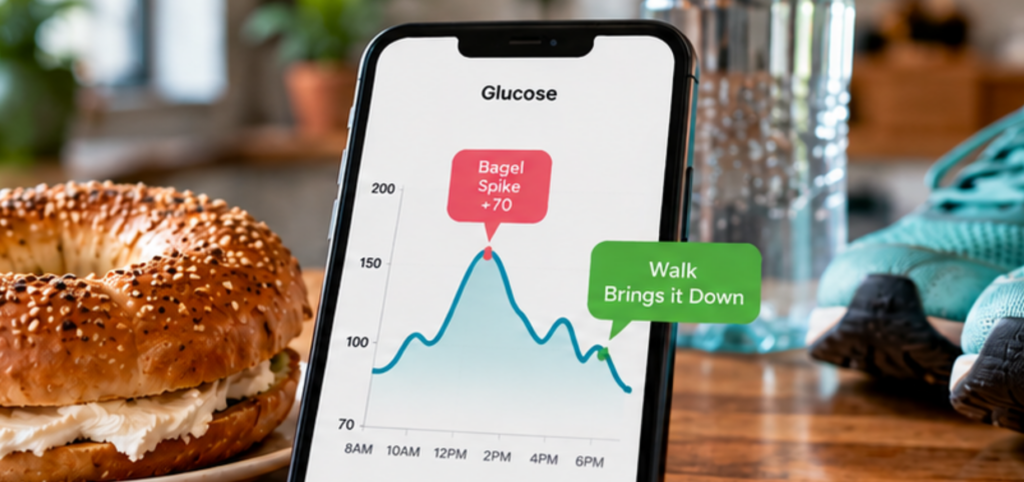
So what’s a spike, exactly? When you eat carbs, your body turns them into sugar, and your blood glucose goes up. Your pancreas sends out insulin to bring it back down. If the spike was sharp, like from a plain bagel or a soda, the crash afterward is usually just as fast, and that’s what gets you. It’s why you’re hungry again an hour later, or why your mood tanks.
The problem with willpower isn’t that you’re weak; it’s that you’re fighting a system already working against you. Knowing that once is interesting. Knowing your own pattern over time? That’s how you actually make better choices.
So why keep checking? One reading shows what one meal did. A few weeks of readings show which foods hit you hardest, which combos smooth things out, adding protein, fat, fiber, or even a quick walk after eating. It also flags which snacks set off that crash-and-crave cycle two hours later. Some people handle oatmeal just fine, others crash hard. Same with that bagel. Throw in some almonds or a little protein, and suddenly the spike isn’t so bad.
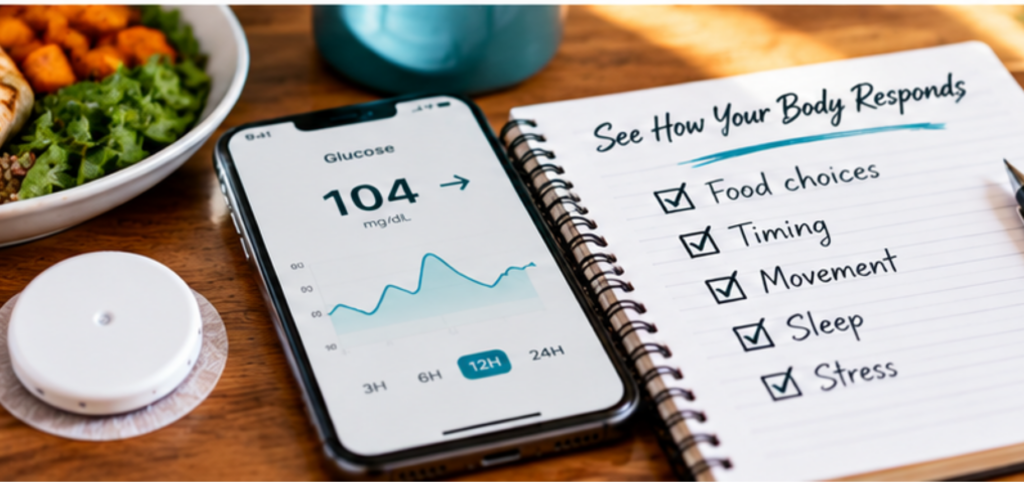
Now, how do you actually check?
| Option | Cost | How It Works | Best For |
|---|---|---|---|
| Basic finger-stick meter (OneTouch, Accu-Chek) | $25–35 one-time for the kit, test strips sold separately | Manual: prick your finger, get one reading, whenever you decide to check | Occasional spot-checks, testing a specific meal, not tracking everything |
| Dexcom Stelo | $89/month subscription, or $99 one-time for a month’s supply (2 sensors, up to 15 days each) | Automatic sensor worn on the arm, reads every 15 minutes, sends everything to an app | Wanting the full day’s picture without lifting a finger |
| Abbott Lingo | About $83/month (2-pack, $82.99, 14 days each), or $48.97 for one sensor | Automatic sensor worn on the arm, continuous tracking sent to an app, with meal and pattern breakdowns | Same as Stelo, if you want more detail in the reporting |
Alright, here are the three ways to check your glucose, no prescription needed. The finger-stick meter is the old-school way. You buy the kit once for twenty-five to thirty-five dollars, then keep buying test strips. Every time you want a reading, you prick your finger and get one number. Good for testing a specific meal or checking in now and then.
The two continuous monitors are Stelo and Lingo. Stelo costs eighty-nine dollars a month on subscription, or ninety-nine dollars for a single month up front. That gets you two sensors, each lasting up to fifteen days. You stick one on your arm, and it reads your glucose every fifteen minutes, sending everything straight to an app. Lingo costs about eighty-three dollars a month for a two-pack, or forty-nine dollars for one sensor. Same idea, arm sensor, continuous tracking, app, but it breaks down meals and patterns in more detail. Both are automatic, both cost about the same, so it’s really about which app you like better.
None of them require a doctor or a diagnosis. The choice comes down to whether you want to do it yourself for cheap or pay more to have it done for you. Stelo and Lingo are close enough in price that the decision is about the app, not the cost.
The numbers give you a clearer picture, but you still have to act on them. These things show you what’s happening in your body. You still have to decide what to eat next, but now you’re making that call with actual data instead of just hoping you’re doing it right. That’s the difference between guessing and knowing.
Thirty dollars and a few test strips might be all you need if you just want to test a couple meals. If you’d rather not think about it and just get the whole day’s picture, either of the continuous monitors will do that.
This isn’t medical advice. If you’ve got diabetes, prediabetes, or you’re on meds that mess with your blood sugar, check with your doctor first. None of these have alerts for highs or lows. That’s a bigger deal if you’re actually managing a condition. Verify current pricing on the manufacturer’s site, since CGM subscription costs change frequently.




 Previous Post
 Next Post