The Other Half of the Holiday Plan

By Dave Prouhet, AFAA-certified trainer and co-owner, Studio Strong, O’Fallon, IL
Updated November 2026
You’ve got your December to-do list mapped out. Year-end close, inventory counts, bonuses to hand out, the office party to plan. And that client who needs their proposal “before the holidays,” which really means right now. You may even have a plan for the food: a smaller second plate, a walk after the party.
Here is the other half of the plan, the part that always gets pushed to the side. Between the last vendor call and the school holiday concert, the workout disappears. So let’s talk about what happens when it does.
Short answer: Think of your strength like something you maintain, not something you pause. Keep those training sessions on the calendar through December, same weights you’ve been using. If one week turns into a mess, there’s still a way to hold on.
What’s the real cost of skipping?
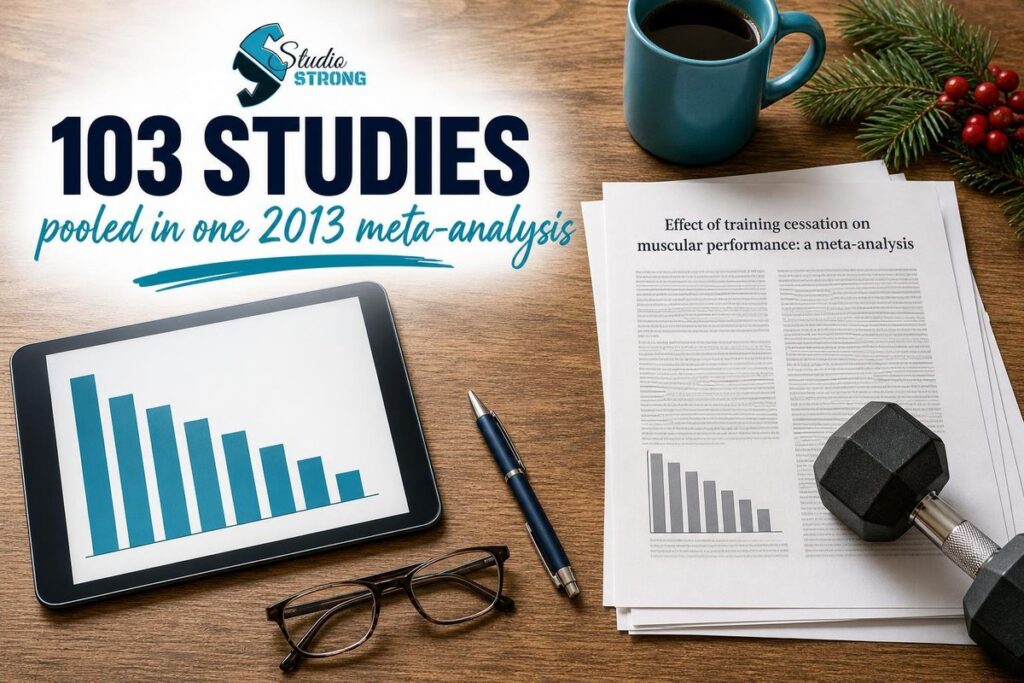
Stopping cold isn’t free. A 2013 meta-analysis of 103 studies found that stopping resistance training lowered every measure of muscular performance the researchers looked at. How much you lose depends on your training history, your age and how long you stay away.
The good news: every session you keep is strength you don’t have to earn back.
Now what if a week just falls apart?
A 2021 review in the Journal of Strength and Conditioning Research pulled together the “minimum dose” studies. Strength and muscle size stayed put for up to 32 weeks on as little as one session a week, or just one set per exercise. The one requirement: the weight couldn’t drop. Most of that evidence comes from younger adults. For older adults, holding on to muscle size may take up to two sessions a week and 2 to 3 sets per exercise.
That’s the floor, and it’s only for the week that goes sideways, not the whole month. The goal is still to keep your regular training, and to protect the one thing the studies kept constant: the weight.

Four rules for December
- Schedule it like a client meeting. Book your December sessions now, before the holiday invites take over.
- Keep the same weights. Going lighter is the common mistake. The studies that held people’s strength kept the weight the same.
- Pick your bad-week rule when you’re calm, so if things fall apart, you already know the answer: move it, don’t cancel it. If it really can’t happen, do one session with one set of each exercise at your usual weights. That’s better than nothing. It’s a placeholder, not the plan. If you’re an older adult, aim higher than the floor, since the research suggests older adults may need a little more.
- Write down your numbers. After every session, log the weights and reps in your phone. When the chaos settles, you’ll know exactly where you left off.

So treat your strength like a standing meeting, not something you squeeze in if time allows.
If you want help building a December plan that fits your actual schedule, our complimentary Strong for Life Consultation is a free conversation about your goals and your time. Book it at studiostrong.fit.
This is general information, not medical advice. If you’re managing an injury or a health condition, check with your healthcare provider before changing how you train.
Sources
- Spiering BA, Mujika I, Sharp MA, Foulis SA. Maintaining physical performance: the minimal dose of exercise needed to preserve endurance and strength over time. J Strength Cond Res. 2021;35(5):1449-1458. PubMed
- Bosquet L, Berryman N, Dupuy O, et al. Effect of training cessation on muscular performance: a meta-analysis. Scand J Med Sci Sports. 2013;23(3):e140-e149. Publisher page