Average Plank Time by Age: How Long Should You Hold It?

By Doreen Warfield, Studio Strong, O’Fallon, IL Updated November 2026
If you’re over 40, holding a forearm plank for 30 to 60 seconds with solid form is a good place to aim, and a clean minute or more is strong. One of the few sourced references we have puts a normal plank for 40-year-olds at about 46 to 56 seconds for women and 84 to 102 seconds for men. Past 40, we found no trustworthy published chart for each decade.
Those charts floating around that tell you exactly how long to plank at your age don’t trace back to any study we could find. Here’s what the real research shows.
What’s the average plank time by age?
Studies don’t all measure the same way. Some stop the clock when you give up, others when your hips start to sag. So the numbers don’t line up perfectly.
| Who was tested | Age | Plank time | Source |
|---|---|---|---|
| 471 college students | About 20 | Median 110 seconds (men), 72 seconds (women) | Strand et al., 2014 |
| “Normal” range a Swedish health study used | 40 | 84 to 102 seconds (men), 46 to 56 seconds (women) | Bornhöft et al., 2024 |
| 120 adults, half aged 20 to 35, half 60 to 79 | 20 to 79 | Whole group averaged 145 seconds; the older half held for significantly less time | Bohannon et al., 2018 |
| Adults in their 50s | 50 to 59 | No published norm found | None |
Age isn’t the only thing that shapes your plank time. People who move more tend to last longer, and people with bigger waistlines usually don’t (Bohannon 2018). A 2025 study of adults 18 to 62 found the older group held for less time, and the researchers linked it to higher body fat (Rodríguez-Perea 2025).
One more thing about the research: the people who sign up for plank studies probably like planks more than the average person.
How long should you hold a plank in your 40s, 50s and 60s?
In your 40s: Stick with the numbers for 40-year-olds. Canadian personal trainer Bryan O’Conner told Global News he considers 60 seconds or more “strong,” and that under 30 seconds is worth a closer look, because it can mean you’re at risk for back problems.
In your 50s: There are no published numbers for this decade. Use the 40s range as a rough guide, and pay attention to your own starting point.
In your 60s and up: The 2018 study found adults 60 to 79 held for significantly less time than the 20 to 35 group. A clean 30 seconds is a decent place to start building from.
For context on the extreme end, Josef Šálek of the Czech Republic set the men’s Guinness World Record in 2023 at 9 hours, 38 minutes and 47 seconds. On the women’s side, DonnaJean Wilde of Alberta, Canada, held a plank for more than five hours in October 2026 at age 61, topping her own 2024 Guinness record of 4 hours, 30 minutes and 11 seconds. Neither one is your baseline.

Is holding a plank longer better?
Not automatically. Stuart McGill, a spine researcher at the University of Waterloo, has called planks past 10 seconds “pointless” for most people. His advice, as quoted by Global News: “Basically holding repeated holds of 10 seconds is best for the average person.”
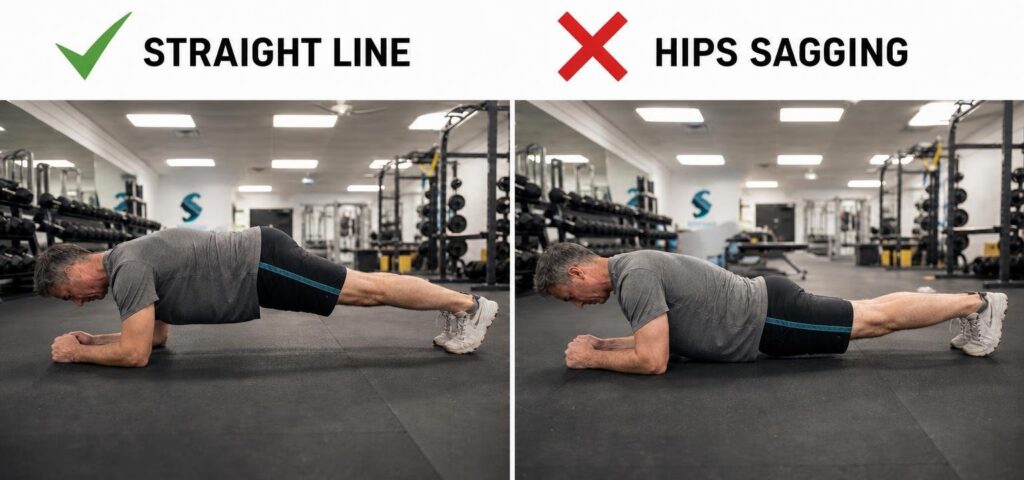
The problem is form. Once you start getting tired, your hips drop and your lower back sags. Some research protocols stop the clock right there (Strand 2014), because every second after that just trains bad posture. Five solid 10-to-20-second planks will do more for you than one sloppy five-minute hold.
Back endurance still matters. A Danish study of 928 adults between 30 and 60 found that men with good back-muscle endurance were less likely to have a first bout of low back trouble (Biering-Sørensen 1984). But a long front plank isn’t a back-health test. In a 2025 study, people with low back pain actually held planks longer than people without it, and balanced endurance between the front core and the back muscles was linked to less disability (Eimiller 2025). McGill’s 1999 research showed women could hold a side plank for only 39% as long as their back-extension hold. So don’t just do front planks. Add side planks and bridges too.
How do you test your plank time safely?
- Spend a few minutes warming up first.
- Get into position on your forearms: elbows under your shoulders, toes on the floor, body in a straight line from head to ankles.
- Start your timer and breathe steadily the whole time. Holding your breath while straining can spike your blood pressure (Mayo Clinic).
- Stop when your hips start to sag, your lower back feels it, or you catch yourself not breathing. That’s your number.
- Write it down and check again in about four weeks.
After you find your number once, train with shorter holds instead of pushing to your limit every time.

How do you modify a plank?
- Forearm plank: easier on your wrists than a plank on your hands.
- Incline plank: hands or forearms on a sturdy bench, counter or wall. The higher your hands, the less weight you’re holding up.
- Knee plank: keep the same straight line, from shoulders to knees.
Start with whichever version lets you hold good form for 20 to 30 seconds, then lower the angle over a few weeks. Modified planks still count. No need to force the full version if it’s not working for you yet.
When should you skip planks?
Check with your doctor or a trainer before planking if any of these sound like you:
- You’ve had surgery lately, especially on your stomach, back or shoulders, or a hernia repair. Your surgeon is the one who says when you’re cleared.
- Your blood pressure is high and not under control, or you have heart problems. Mayo Clinic says to talk to your provider first and keep the effort moderate. Isometric moves may even help lower blood pressure over time (Harvard Health, 2023), but you still need the green light.
- You’re pregnant, especially in the later months. Check with your OB or midwife, as MotherToBaby’s exercise fact sheet advises.
- Your shoulders hurt. Planks put a lot of weight through them, so get it looked at and ask a trainer for a different core move.
If a plank ever causes sharp pain, stop right there. This is general education, not medical advice. If you have a health condition, your doctor is the one to ask.
What is Planksgiving?
Planksgiving is our free November plank challenge at plank.challengeclub.app. It runs November 1 to 30, with make-up days through December 4. Finish all 30 days and you get a $45 Studio Strong credit. Pick your level, hold the day’s plank to earn a feather, and fill your turkey with 30 feathers.
FAQ
Is a 1-minute plank good for a 50-year-old?
Yes. There’s no published norm for people in their 50s, but a clean minute is above the normal range researchers used for 40-year-old women (46 to 56 seconds) and a bit under the range for 40-year-old men (84 to 102 seconds).
How often should I do planks?
Planks count as muscle-strengthening exercise. The Physical Activity Guidelines for Americans recommend that kind of activity at least 2 days a week, and short plank sets fit right in.
Do planks burn belly fat?
Not on their own. In a 6-week study, people who did ab exercises 5 days a week improved their ab endurance but didn’t lose any more belly fat than the group that skipped them (Vispute 2011).
Is a knee plank still worth doing?
Absolutely. You’re still practicing the same straight-line position, just with less weight to hold. Build up there, then move to a full plank when you’re ready.
Should I hold my breath during a plank?
No. Breathe steadily the whole time. Holding your breath while straining can make your blood pressure spike dangerously (Mayo Clinic).
Sources
- Strand SL, Hjelm J, Shoepe TC, Fajardo MA. Norms for an isometric muscle endurance test. Journal of Human Kinetics. 2014;40:93-102. https://pmc.ncbi.nlm.nih.gov/articles/PMC4096102/
- Bornhöft L, Arvidsson D, Bergenheim A, et al. Development and feasibility of a function-based preventive intervention for lifestyle-related disorders. BMC Public Health. 2024;24:681. (Plank reference values for 40-year-olds, Table 3.) https://pmc.ncbi.nlm.nih.gov/articles/PMC10910714/
- Bohannon RW, Steffl M, Glenney SS, et al. The prone bridge test: performance, validity, and reliability among older and younger adults. Journal of Bodywork and Movement Therapies. 2018;22(2):385-389. https://doi.org/10.1016/j.jbmt.2017.07.005 (abstract only)
- Rodríguez-Perea Á, Aragón-Aragón P, Cuenca-García M, et al. Criterion-related validity and reliability of the front plank test in adults: the ADULT-FIT project. Applied Sciences. 2025;15(5):2722. https://www.mdpi.com/2076-3417/15/5/2722
- McGill SM, Childs A, Liebenson C. Endurance times for low back stabilization exercises: clinical targets for testing and training from a normal database. Archives of Physical Medicine and Rehabilitation. 1999;80:941-944. https://doi.org/10.1016/s0003-9993(99)90087-4 (abstract)
- Biering-Sørensen F. Physical measurements as risk indicators for low-back trouble over a one-year period. Spine. 1984;9(2):106-119. https://doi.org/10.1097/00007632-198403000-00002 (abstract)
- Eimiller K, LeFevre L, Robarge C, et al. The core of the issue: plank performance and pain in the lower back. Journal of Clinical Medicine. 2025;14(11):3926. https://doi.org/10.3390/jcm14113926 (abstract)
- Global News, April 18, 2018. Plank-duration article quoting Stuart McGill (via The Telegraph) and trainer Bryan O’Conner. https://globalnews.ca/news/4149572/how-long-hold-plank/
- Mayo Clinic Staff. Isometric exercises: Good for strength training? Mayo Clinic, November 18, 2023. https://www.mayoclinic.org/healthy-lifestyle/fitness/expert-answers/isometric-exercises/faq-20058186
- Corliss J. The best strength-building exercise to lower blood pressure? Harvard Health Publishing, December 1, 2023. https://www.health.harvard.edu/heart-health/the-best-strength-building-exercise-to-lower-blood-pressure
- MotherToBaby (Organization of Teratology Information Specialists). Exercise fact sheet, March 2024. https://www.ncbi.nlm.nih.gov/books/NBK582697/
- U.S. Office of Disease Prevention and Health Promotion. Top 10 Things to Know About the Second Edition of the Physical Activity Guidelines for Americans. https://odphp.health.gov/our-work/nutrition-physical-activity/physical-activity-guidelines/current-guidelines/top-10-things-know
- Vispute SS, Smith JD, LeCheminant JD, Hurley KS. The effect of abdominal exercise on abdominal fat. Journal of Strength and Conditioning Research. 2011;25(9):2559-2564. https://doi.org/10.1519/jsc.0b013e3181fb4a46 (abstract)
- Guinness World Records. Longest time in an abdominal plank position (male): Josef Šálek, 9:38:47, Pilsen, Czechia, May 20, 2023. https://www.guinnessworldrecords.com/world-records/longest-time-in-an-abdominal-plank-position
- Guinness World Records. Longest time in an abdominal plank position (female): DonnaJean Wilde, 4:30:11, Magrath, Alberta, March 21, 2024. https://guinnessworldrecords.com/world-records/longest-time-in-an-abdominal-plank-position-(female)
- Daily Hive, October 8, 2026. A 61-year-old Alberta grandmother holds a plank for more than five hours at the Huntsman World Senior Games (Oct 5, 2026). https://dailyhive.com/canada/canadian-world-record-five-hour-plank