
How Many Calories Are in Thanksgiving Dinner?
By Doreen Warfield, Studio Strong, O’Fallon, IL Updated November 2026
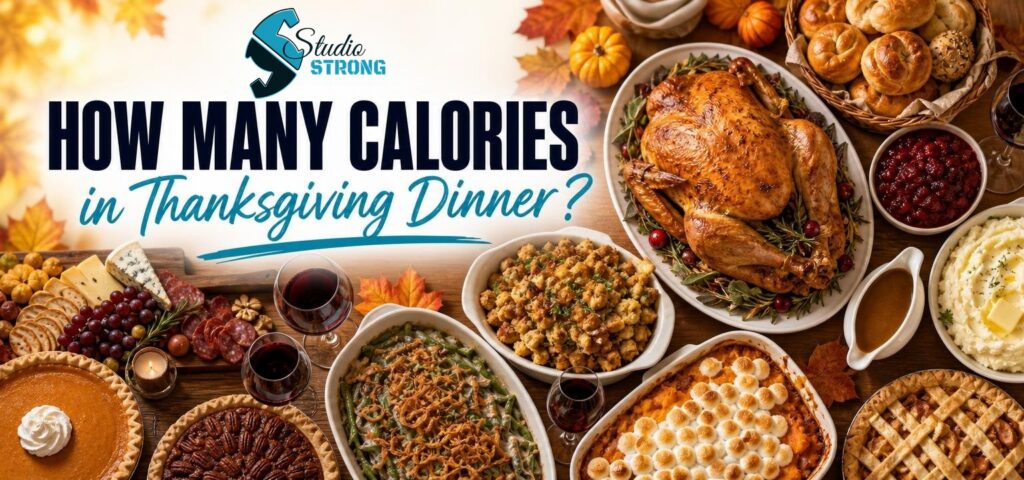
Thanksgiving dinner isn’t 4,500 calories. That number gets tossed around every year, but it’s way off. A typical plate of turkey and sides runs about 1,400. Add a slice of pumpkin pie and a glass of wine and you’re at about 2,000. Second helpings and a slice of pecan pie can push you past 3,600, and that pie alone accounts for 674 of them. The 4,500 figure is a trade group’s estimate for an entire day of eating: snacks, drinks, the whole thing.
Where did the 4,500-calorie Thanksgiving number come from?
It started with the Calorie Control Council, an industry group for makers of low-calorie foods and sweeteners. The number has been around since at least 2006, when the American Council on Exercise used the same math in a press release.
It’s menu math. The Council added up a sample dinner with big portions (pecan pie and a tablespoon of butter included) and got about 3,000 calories. Then it tacked on roughly 1,500 more for appetizers and drinks before and after the big meal. None of the coverage points to anyone weighing real people’s plates.
In 2012, New York Times health writer Tara Parker-Pope built the most indulgent dinner she could and got 2,486 calories. Dietitian Jamie Pope told ABC News the 4,500 count seemed “inflated.”

How many calories are in a Thanksgiving meal?
Here’s a realistic plate, built from USDA FoodData Central. Your aunt’s version may vary, especially if she measures butter by the stick.
| Food | Portion | Calories |
|---|---|---|
| Turkey, light and dark meat, skin on | 6 oz | 311 |
| Bread stuffing | 3/4 cup | 266 |
| Mashed potatoes | 3/4 cup | 214 |
| Poultry gravy | 1/4 cup | 29 |
| Green bean casserole* | 1/2 cup | 64 |
| Candied sweet potatoes | 1/2 cup | 234 |
| Cranberry sauce | 1/4 cup | 111 |
| Dinner roll with a pat of butter | 1 medium roll | 172 |
| Dinner plate | 1,401 | |
| Pumpkin pie with whipped topping | 1/8 of a 9-inch pie, 1/4 cup topping | 434 |
| Red wine | 1 glass (about 6 oz) | 153 |
| Total | 1,988 |
*USDA’s green bean casserole recipe leaves off the fried onions. Your family’s probably doesn’t.

That plate weighs about 2.8 pounds and carries about 3,300 mg of sodium. The FDA’s Daily Value for sodium is under 2,300 mg, for the whole day. Hang on to both numbers for Friday.
How many calories do people eat on Thanksgiving?
Depends on the plate and how many times you go back. Same USDA numbers, two more versions:
| Version | What changes | Calories |
|---|---|---|
| Lighter plate | Skinless turkey first, half the stuffing and potatoes, a full cup of green bean casserole, small pie slice, same wine, roll skipped (unless Grandma made it) | 1,262 |
| Typical plate | The table above | 1,988 |
| Second helpings | Typical plate, plus 4 oz turkey, 1/2 cup each of stuffing and potatoes with gravy, a roll, pecan pie with topping, a second glass of wine | about 3,600 |
A slice of pecan pie is 674 calories by itself. It earns every one.
Throw in breakfast, chips and dip all afternoon, and a turkey sandwich at 10 p.m., and for the seconds crowd 4,500 suddenly doesn’t sound so wild.
Can you gain weight in one day?
On the scale, yes. The scale can jump a few pounds from three things: food still in your gut, water, and a little actual fat.
Some of it’s just food still sitting there. A typical Thanksgiving plate weighs about 2.8 pounds. Go back for seconds and that jumps to about 4.6 pounds, before you even pour coffee or water.
Water comes from glycogen and sodium. Your body stores carbs as glycogen, and every gram of glycogen is stored with three or four grams of water. Stash an extra 100 grams of glycogen from the stuffing and pie, and 300 to 400 grams of water come along. Together, that’s close to a pound. Sodium adds more. The American Heart Association lists water retention, puffiness and weight gain as effects of too much salt, and one plate already has about 3,300 mg.
Fat is slower. The old rule says a pound of body fat holds about 3,500 calories, based on a 1958 estimate of the energy in fat tissue. Kevin Hall at NIH says it works for modest changes in heavier people but runs high for others. Over months, your body adjusts and the rule stops being accurate. For one day, though, it’s a fair napkin estimate. If you usually burn about 2,000 calories and eat 4,500, the extra 2,500 works out to about 0.7 pounds of fat, at most.
The food and water drop off once you eat normally again.
How much weight do people gain over the holidays?
Less than the “5 pounds” people like to quote. A 2000 NIH study in the New England Journal of Medicine tracked 195 adults from fall to spring. On average, they gained 0.37 kg, about 0.8 pounds, between mid-November and early January.
The catch is it didn’t go away. By March, they were up about a pound from September, and it was still there the next fall. One Thanksgiving meal matters less than the whole six-week stretch. The goal is maintenance, so January can be about moving forward.

How should you build a Thanksgiving plate after 40?
That holiday pound tends to stick around, so what you put on your plate still counts. Start with protein, then add the sides and pie you really want, then take a walk.
Four ounces of roasted turkey has about 31 grams of protein. Research on aging muscle suggests 25 to 30 grams of protein per meal gets the strongest muscle-building response in younger and older adults. An international expert group, PROT-AGE, recommends adults over 65 get at least 1.0 to 1.2 grams of protein per kilogram of body weight daily, and more if they’re active. Protein also gives a modest boost in fullness, which leaves less room for the third roll.
Now for the rest of the plate. Take a scoop of each side you’d actually miss if it wasn’t there. Skip the ones you only eat out of habit, like the roll you grab because it’s sitting there. Pick the pie you love. If you can’t choose, two small slices work.
Then walk. Ten to fifteen minutes at a comfortable pace. In adults 60 and older at risk for high blood sugar, three 15-minute walks after meals lowered after-dinner glucose more than one 45-minute walk. In adults with type 2 diabetes, a 10-minute walk after each meal lowered post-meal blood sugar 12% compared with one daily 30-minute walk. After the evening meal, the drop was 22%.
If you have diabetes or take medication that lowers blood sugar, ask your doctor how walking after meals fits your plan.
Doing Planksgiving this month (Nov 1 to 30, with make-up days through Dec 4, plank.challengeclub.app)? Thanksgiving Day’s plank counts. Do it before the pie.
Thanksgiving calories FAQ
How many calories are in a Thanksgiving meal?
A typical plate of turkey and all the sides runs about 1,400 calories. With a slice of pumpkin pie and a glass of wine, it climbs to about 2,000. Those numbers are based on USDA FoodData Central values.
How many calories do people eat on Thanksgiving?
A full plate with dessert and wine adds up to about 2,000 calories. Seconds and pecan pie push it to about 3,600. The 4,500-calorie figure is the Calorie Control Council’s estimate for an entire day of eating, appetizers and drinks included.
Can you gain weight in one day?
The scale might show a few extra pounds the next morning, but most of that is food still in your system and water held by glycogen and sodium. Actual fat gain from one big day is small: eating 2,500 calories more than you burn works out to about 0.7 pounds at most.
How much weight do people gain over the holidays?
About 0.8 pounds (0.37 kg) on average, in a 2000 NIH study of 195 adults published in the New England Journal of Medicine. The gain was small, but it stuck around: it was still there the following fall.
How much turkey gives you 25 to 30 grams of protein?
About 4 ounces of roasted turkey. According to USDA FoodData Central, that’s roughly 31 grams of protein.
Sources
Nutrition data
- USDA FoodData Central, Food and Nutrient Database for Dietary Studies (FNDDS) survey foods, release of October 31, 2024. Values per 100 g, scaled to the portions shown using FNDDS portion weights. FDC IDs: turkey with skin 2706114, turkey without skin 2706113, bread stuffing 2707687, mashed potatoes made with milk 2709496, poultry gravy 2707144, green bean casserole 2710040, candied sweet potato 2709704, cranberry sauce 2709280, soft white roll 2707654, butter 2710155, pumpkin pie 2708011, pecan pie 2708015, whipped topping 2705611, red wine 2710688. https://fdc.nal.usda.gov/download-datasets
- U.S. Food and Drug Administration, “Sodium in Your Diet.” https://fda.gov/media/84261/download
Where 4,500 came from
- American Council on Exercise, “Hard to Believe: Average Thanksgiving Meal Equals 3,000 Calories and 229 Grams of Fat,” press release, November 21, 2006. https://www.acefitness.org/about-ace/press-room/press-releases/392/hard-to-believe-average-thanksgiving-meal-equals-3-000-calories-and-229-grams-of-fat/
- Fox News, “How many calories are in a Thanksgiving meal?” November 21, 2018 (quotes the Calorie Control Council’s 3,000 + 1,500 breakdown and its sample menu). https://www.foxnews.com/food-drink/how-many-calories-are-in-a-thanksgiving-meal.amp
- Sydney Lupkin, “How Many Calories You’ll Eat This Thanksgiving,” ABC News, November 25, 2014 (Calorie Control Council as an industry group for diet food companies; Tara Parker-Pope’s 2,486-calorie meal; dietitian Jamie Pope’s “inflated”). https://abcnews.com/Health/calories-eat-thanksgiving/story?id=27168135
- Morgan Korn, “How Many Calories Americans Will Eat on Thanksgiving,” ABC News, November 23, 2016. https://abcnews.com/Health/calories-americans-eat-thanksgiving/story?id=43690796
- TIME NewsFeed, “Is a Thanksgiving Dinner Really 4,500 Calories?” (Parker-Pope’s menu test). https://newsfeed.time.com/?p=182209
- Calorie Control Council, organization description. https://caloriecontrol.org/simple-tips-to-avoid-holiday-weight-gain/
Water, sodium and the 3,500-calorie rule
- Kreitzman SN, Coxon AY, Szaz KF. Glycogen storage: illusions of easy weight loss, excessive weight regain, and distortions in estimates of body composition. Am J Clin Nutr. 1992;56(1 Suppl):292S-293S. https://pubmed.ncbi.nlm.nih.gov/1615908/
- American Heart Association, “Effects of Excess Sodium Infographic.” https://www.heart.org/healthy-living/healthy-eating/eat-smart/sodium/effects-of-excess-sodium-infographic
- Wishnofsky M. Caloric equivalents of gained or lost weight. Am J Clin Nutr. 1958;6(5):542-546. https://pubmed.ncbi.nlm.nih.gov/13594881/
- Hall KD, Chow CC. Why is the 3500 kcal per pound weight loss rule wrong? Int J Obes. 2013;37(12):1614. https://pmc.ncbi.nlm.nih.gov/articles/PMC3859816/
- Thomas DM, et al. Can a weight loss of one pound a week be achieved with a 3500-kcal deficit? Int J Obes. 2013;37(12):1611-1613. https://pubmed.ncbi.nlm.nih.gov/23628852/
Holiday weight gain
- Yanovski JA, et al. A prospective study of holiday weight gain. N Engl J Med. 2000;342(12):861-867. https://pubmed.ncbi.nlm.nih.gov/10727591/
Protein and walking
- Paddon-Jones D, Rasmussen BB. Dietary protein recommendations and the prevention of sarcopenia. Curr Opin Clin Nutr Metab Care. 2009;12(1):86-90. https://pubmed.ncbi.nlm.nih.gov/19057193/
- Bauer J, et al. Evidence-based recommendations for optimal dietary protein intake in older people: a position paper from the PROT-AGE Study Group. J Am Med Dir Assoc. 2013;14(8):542-559. https://pubmed.ncbi.nlm.nih.gov/23867520/
- Leidy HJ, et al. The role of protein in weight loss and maintenance. Am J Clin Nutr. 2015;101(6):1320S-1329S. https://pubmed.ncbi.nlm.nih.gov/25926512/
- DiPietro L, et al. Three 15-min bouts of moderate postmeal walking significantly improves 24-h glycemic control in older people at risk for impaired glucose tolerance. Diabetes Care. 2013;36(10):3262-3268. https://pubmed.ncbi.nlm.nih.gov/23761134/
- Reynolds AN, et al. Advice to walk after meals is more effective for lowering postprandial glycaemia in type 2 diabetes mellitus than advice that does not specify timing. Diabetologia. 2016;59(12):2572-2578. https://pubmed.ncbi.nlm.nih.gov/27747394/




 Previous Post
 Next Post