Don’t Back Off in December: How to Keep Training Through the Holidays
By Studio Strong
Updated November 2026
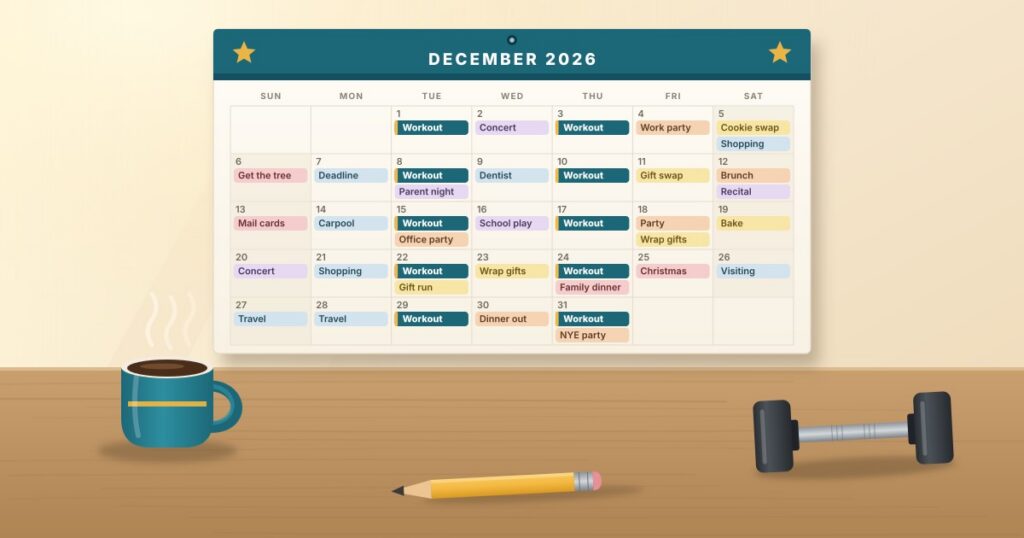
Come early December, your schedule fills up. School concerts, office parties, that cookie exchange you said yes to in October when it felt far away. Then someone brings home the latest bug making the rounds. Workouts get pushed, then forgotten, then pushed again until January.
So here’s what we say: don’t back off.
Short answer: Keep your sessions on the calendar, same as always, same weights too. December isn’t the month to cut back. It’s the month to hold the line. If one week goes sideways, there’s still a way to keep moving without losing ground.
Why December matters more than you think
Stop training completely, and you start losing ground. The longer you stay away, the more it costs you. A 2013 meta-analysis found that stopping resistance training lowered every measure of muscular performance the researchers looked at. The analysis included 103 studies. The amount depends on your training history, your age, and how long the break lasts.
It’s not just physiology working against you, either. Routines don’t disappear because you decide to quit. One session gets skipped for a good reason. That makes the next one easier to skip.
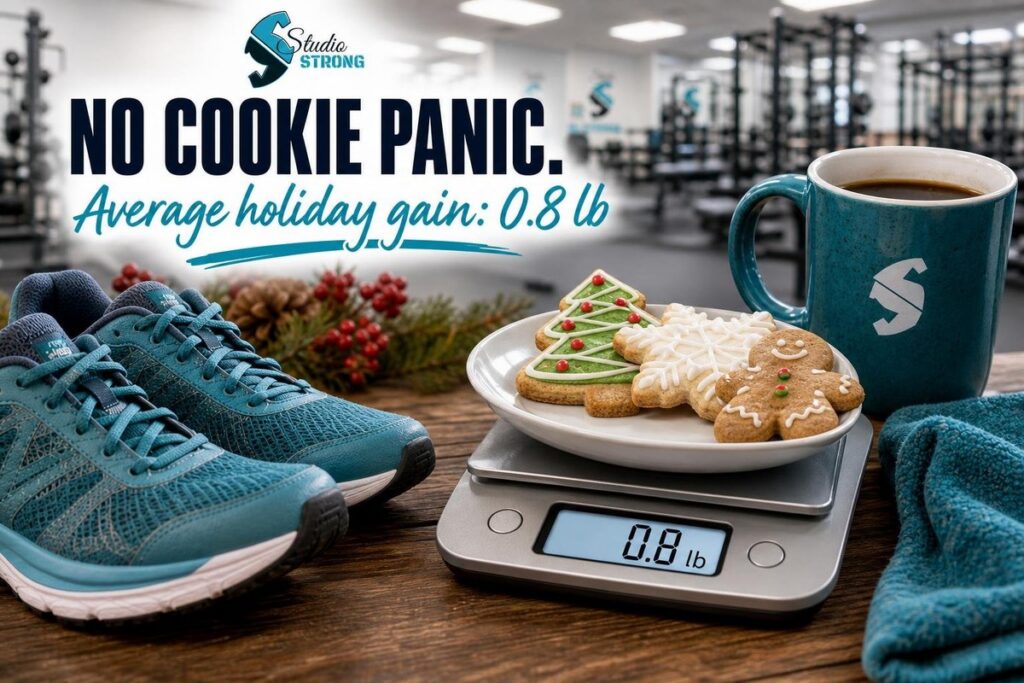
It’s not just your workouts at risk this time of year. Holidays aren’t an excuse to coast either. A 2000 study in the New England Journal of Medicine followed 195 adults through the holidays and found an average gain of 0.37 kg, about 0.8 of a pound. Some people gained more (a later summary of the study put it at about 1 in 7 gaining more than five pounds), and the average gain had not come off by late winter. That’s not a reason to stress over a single cookie. It’s a reason to keep showing up.
How to make it through December without losing ground
Five things to do now:
- Book your December sessions today. Put them on the calendar like appointments before everything else fills up.
- Plan around the days that change. We’re open mornings only on December 24, closed December 25, and done by 4 p.m. on December 31. Book those weeks early.
- Keep lifting the same weights. Going lighter “just in case” is the mistake everyone makes. The research that kept people strong didn’t cut the weight, it cut the sessions or the sets instead.
- Don’t cancel. Reschedule within the same week.
- Move a little between sessions. A walk after dinner counts.
What if a week goes completely off the rails?
Then use the floor. A recent review pulled together the “minimum dose” studies. It appeared in the Journal of Strength and Conditioning Research in 2021. Strength and muscle size held steady for up to 32 weeks on as little as one session a week, or as little as one set per exercise, as long as the weight stayed the same. Most of that research was done on younger adults. For older adults, holding on to muscle size may take up to two sessions a week and 2 to 3 sets per exercise.
Age matters too. A 2011 trial followed 70 adults, some 20 to 35 years old and some 60 to 75, through 16 weeks of training. For the next 32 weeks, they either stopped completely or trained at one-third or one-ninth of their original amount. The older group needed more weekly training than the younger group to keep their muscle size.
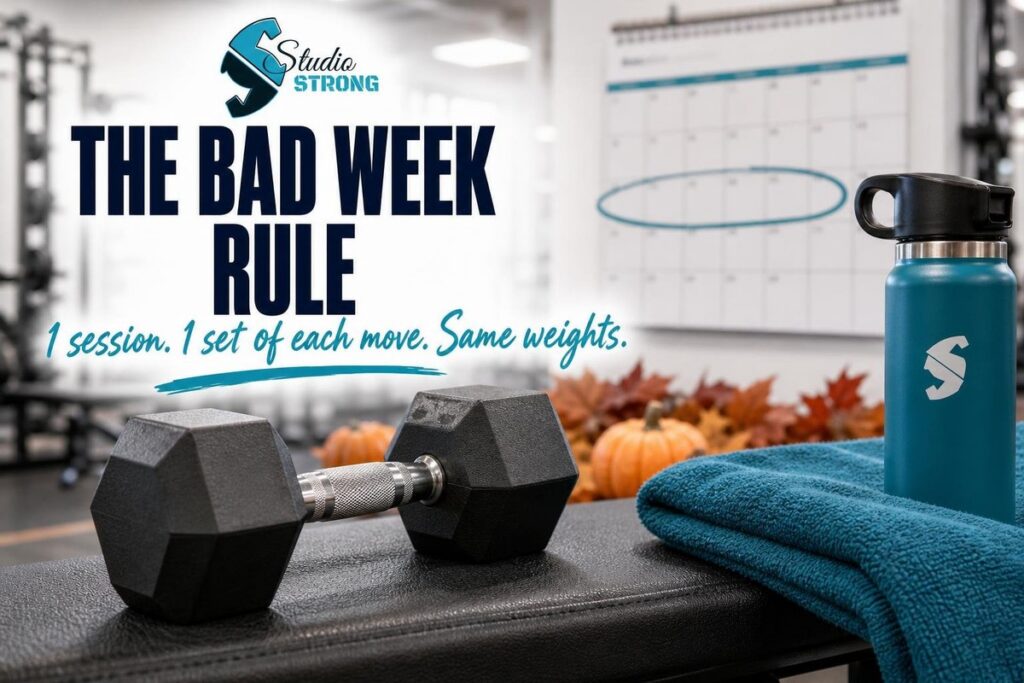
So decide your Bad Week rule now, when you’re thinking clearly. One session. One set each of five basic moves: a squat or sit-to-stand, a hip hinge like a deadlift, a push, a pull, and a carry or plank. Keep the weights the same. It’s still better than nothing. It’s a placeholder, not a plan, and if you’re over 60, aim for a little more.
Where people go wrong in December
Four things we see every year:
Waiting for the perfect week. Between Thanksgiving and New Year’s, that week doesn’t exist.
Starting a new program the week you’re hosting family. Different moves mean fresh soreness, and December is not the time for that.

Treating a skipped week like a verdict. It’s just a skipped week.
Putting everything off until January.
Quick win: Open your calendar right now and book your next two weeks. That’s the whole plan.
Let the holidays have your evenings. Your routine doesn’t have to disappear.
Need a plan built around your actual December? Our complimentary Strong for Life Consultation is a free conversation about your goals and your schedule. Book it at studiostrong.fit.
This is general information, not medical advice. If you’re managing an injury or a health condition, check with your healthcare provider before changing how you train.
Sources
- Spiering BA, Mujika I, Sharp MA, Foulis SA. Maintaining physical performance: the minimal dose of exercise needed to preserve endurance and strength over time. J Strength Cond Res. 2021;35(5):1449-1458. PubMed
- Bickel CS, Cross JM, Bamman MM. Exercise dosing to retain resistance training adaptations in young and older adults. Med Sci Sports Exerc. 2011;43(7):1177-1187. PubMed
- Bosquet L, Berryman N, Dupuy O, et al. Effect of training cessation on muscular performance: a meta-analysis. Scand J Med Sci Sports. 2013;23(3):e140-e149. Publisher page
- Yanovski JA, Yanovski SZ, Sovik KN, et al. A prospective study of holiday weight gain. N Engl J Med. 2000;342(12):861-867. PubMed. The “about 1 in 7” (14%) figure is from a summary of the study: Nutr Rev. 2000;58(12):378-379. PubMed